
“The season is ended. There was not enough of it; there never is.” – Nick Lyons
DRAWING THE LINE
It’s hard to say what exactly constitutes the “off” season in a province with very few seasonal closures and a long list of popular winter steelhead fisheries. But when people start looking at me sideways when I tell them my weekend plans include standing in a river, that’s usually a pretty good clue.
In early February of this year, I decided to try my hand at “off-season” fishing. It had been far too long since I had caught a fish, and I figured worst-case-scenario I’d end up freezing cold, soaking wet, and skunked, which was a feeling I was quite comfortable with at this point in my life.
They say you have to get wet to catch trout. The problem with winter fishing in B.C., though, is that you almost always get wet whether or not the trout show up. Nonetheless, I ignored the weekend’s forecast and decided it would be worth trying. If nothing worked out, I could disguise some of the blame under the mystique of “steelheading” and explain to my Monday morning coworkers that the numb feet and pruned fingers were just the price you have to pay for the privilege of maybe, someday, laying eyes on one. How was your weekend?
DOWNSIZING
I decided drifting beads would be my method. The salmon run was long over, but I figured a few eggs could still be popping up here and there, and my only other option was white flesh flies, which somehow did not make it into my tackle box on this particular day.
Thanks to an unseasonably warm and dry start of the year here in B.C., rivers were running low and clear, so I downsized my rig. I changed out my standard 25-gram float and ¾ oz weight for a small 10-gram float with light split shot spaced apart underneath in a shirt-button pattern to help the bead drift ahead of the float and avoid being seen.
I started off wading down the river around 8:30 that Saturday, a bit later than my normal crack-of-stupid start. There were a handful of other anglers out for steelhead, and one had just entered the river in front of me, so I let him go ahead of me and slowly trailed him from afar, working the marginal water along the sides of the bank. The day started off slow, and I told myself that any fish, no matter the size or species would make the day.
Eventually, I came across a textbook run—long and wide, with slow walking-speed current, overhanging banks, and tree branches. This was the stuff of dreams. I got to work picking it apart starting at the head of the riffle. Along the inside bank, I got a bobber down and landed a small whitefish, which satisfied my desire for “a” fish, but reminded me that I was really after trout. Either way, I was a little impressed that a fish with such a tiny mouth could be caught with a bead.
With my faith restored, I continued down toward the middle of the run and got my first hit from a trout. It was on a heroically long drift—maybe around 70 yards, and I could barely see the tiny float dip, but when it went down, I lifted my rod tip, reeled in the slack line like my life depended on it, and felt the weight of a large trout. In a flash, the fish jumped two feet out of the water, pirouetted, and threw my hook. It was all over before I even knew what was going on. The only thing I had to show for it was the image of that overly acrobatic fish, frozen mid-air, burned into my brain.
THE PAYOFF
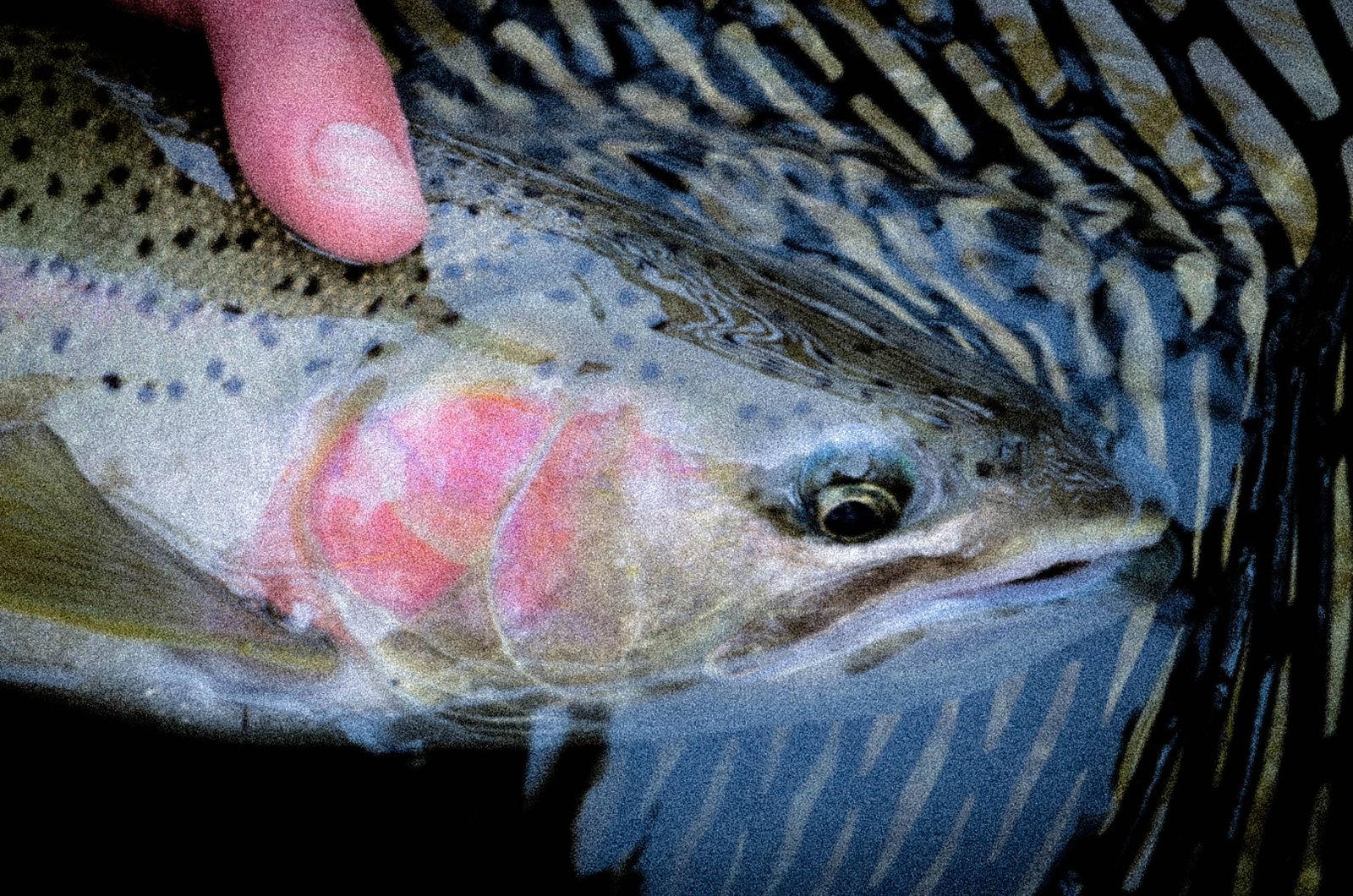
The rain started picking up, but my resolve was strengthened by my recent missed connection. I persisted down the run, wading into deeper water, and continued working my float through the pockets and likely looking feeding lanes. About midway through the run, I cast my float into a dark side pocket and watched its characteristic orange top drift slowly downstream like an orange button waiting to be pressed by the fishing gods. When it was just downstream of me, it sank, and I set the hook cleanly into a hefty trout. It shook its head and peeled out line in three fast runs before obliging the net. I stared down in amazement to admire the twenty-inch rainbow trout in my hands.
The fish was unlike any rainbow I’d seen before—heavily spotted with large black dots from back to belly, bright green and silver in the body, with blazing pink-purple cheeks and a matching stripe along its lateral line. It was a big one too, with a heavy head and thick shoulders that were built all the way back into a well-established tail. I snapped a couple of photos of the beast and carefully slipped him back into the water to live another day.
Alongside the banks of the river were some houses, and from where I stood, I could see a man watching curling on TV. How Canadian, I thought. For a moment, I judged him—how could someone sit inside watching curling of all things, when fishing like this could be had from your front yard? I quickly dismissed the notion. I’d be selective about weather too if I lived on a trout stream. I fished on and caught a spirited little cutthroat before throwing in the towel. My bite-to-hookup percentage was dropping fast, and I thought it best to quit while I was ahead.
Days like these make me wonder what “off-season” even means. Some steelhead guys live for these winter months. I’m more of a summer–fall person, but after a long dry spell, I’ll happily take what I can get.
Related: The Ascension of An Angler
Undoubtedly, when the water is cold and food is scarce, trout go into a sort of semi-hibernation. Their metabolism slows down; feeding becomes less active, and they move around less. They won’t “chase” your fly or lure.
All of this is to say that you’ll have to work harder for the chance at one. Most days, the reward is just fresh air and a pleasant silence that you couldn’t get at home. And then, every so often, a trout reminds you you weren’t crazy either.